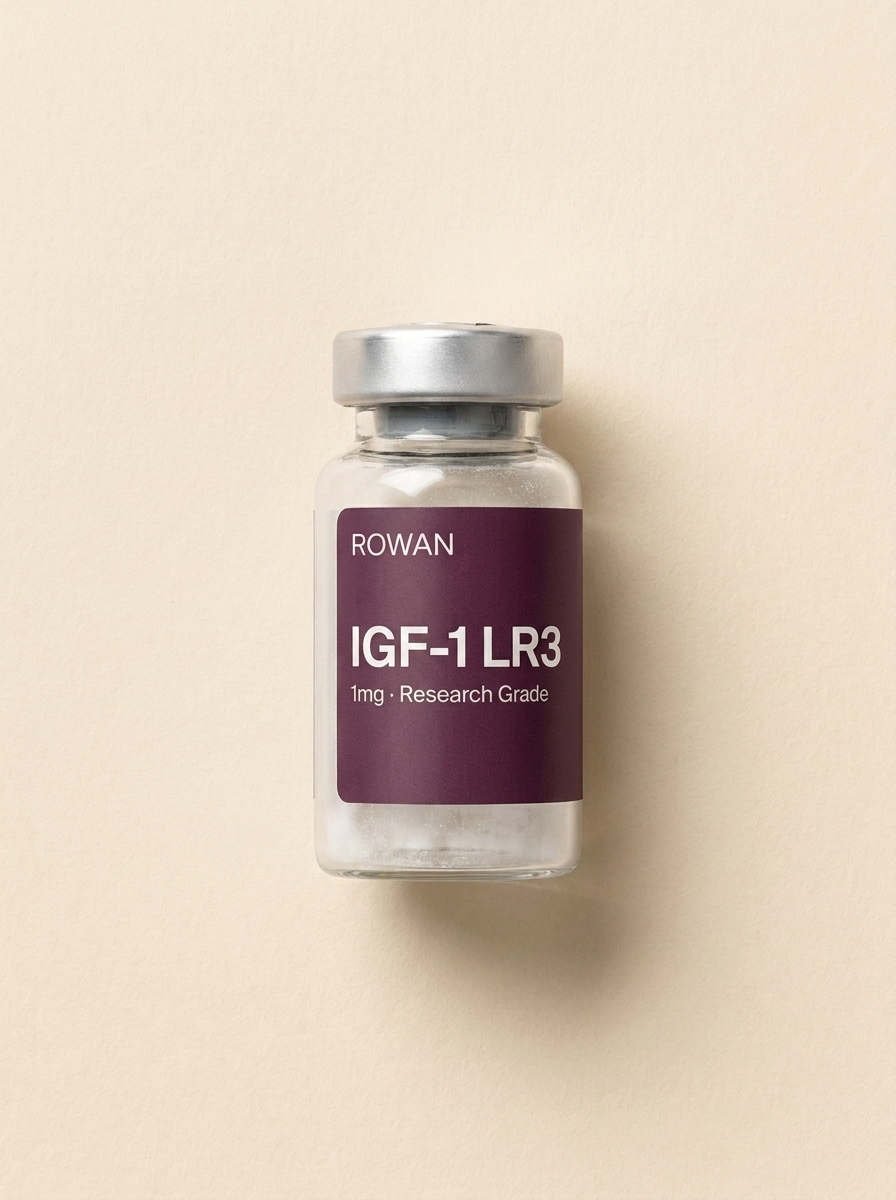
IGF-1 LR3
Long-Arg3 insulin-like growth factor 1 — a 83-amino acid recombinant variant engineered for extended half-life and reduced IGF binding protein affinity. Studied in anabolism, muscle protein synthesis, and satellite cell research.
For laboratory and in vitro research purposes only. Not for human consumption.
What is IGF-1 LR3?
IGF-1 LR3 is an engineered variant of insulin-like growth factor 1 (IGF-1) with two structural modifications: an arginine substitution at position 3 that reduces binding to IGF binding proteins (IGFBPs) by approximately 500-fold, and a 13-amino acid N-terminal extension that extends its plasma half-life to 20–30 hours. These modifications make it significantly more bioavailable at the receptor level than native IGF-1, and more practical for preclinical experimental designs requiring sustained IGF-1 signalling. It is a standard research tool in cell biology and muscle physiology labs.

20-30 hour half-life.
500x less binding protein.
Two modifications distinguish IGF-1 LR3 from native IGF-1: the Arg3 substitution reduces IGFBP binding 500-fold, dramatically increasing bioavailability. The 13-amino acid extension extends half-life from hours to roughly a day. For research requiring sustained IGF-1 signalling, this is the standard tool.
How IGF-1 LR3 works in research models
IGF-1 LR3 is an engineered analogue of native IGF-1 with two structural modifications that reduce binding to IGFBPs (~500-fold) and extend plasma half-life to approximately 20–30 hours. It activates the IGF-1R receptor, initiating PI3K/Akt/mTOR and MAPK signalling — pathways central to cell proliferation, protein synthesis, glucose uptake, and satellite cell activation in skeletal muscle research.
mtor and pi3k.
studied in muscle and cell research.
IGF-1 LR3 activates the IGF-1 receptor, initiating PI3K/Akt/mTOR and MAPK signalling — pathways central to cell proliferation, protein synthesis, and satellite cell activation in skeletal muscle research. A standard reagent in cell biology labs worldwide.
Insulin-like growth factors 1 and 2 in bovine colostrum. Sequences and biological activities compared with those of a potent truncated form.
Biochem J · 1988 · PMID: 3048536
Insulin-like growth factor-I (IGF-I) and especially IGF-I variants are anabolic in dexamethasone-treated rats.
Biochem J · 1992 · PMID: 1329962
In vitro cell culture research typically uses IGF-1 LR3 at 1–100 ng/mL. In vivo rodent studies use 10–100 mcg/kg doses. Reconstitute in acidified sterile water or acetic acid solution. Stable at −80°C long-term; avoid repeated freeze-thaw cycles.
You ask, we answer.
The LR3 modifications reduce binding to IGFBPs by approximately 500-fold. Since IGFBPs sequester native IGF-1, LR3 has dramatically more bioavailable hormone at the receptor level, and its extended half-life (~20–30h vs ~12h) makes it more practical for preclinical experimental designs.
No. MGF (mechano growth factor) is an IGF-1 splice variant produced locally in muscle tissue in response to mechanical stress. IGF-1 LR3 is a synthetic, systemically circulating analogue engineered for extended half-life and IGFBP resistance.
IGF-1 LR3 binds the IGF-1 receptor (IGF-1R) and activates two primary downstream pathways: PI3K/Akt/mTOR (which drives protein synthesis, cell growth, and glucose uptake) and the MAPK/ERK pathway (which drives cell proliferation and differentiation). In skeletal muscle research, it is used to study satellite cell activation and muscle protein synthesis.
IGF-1 LR3 is more sensitive to degradation than smaller peptides. For long-term storage, −80°C is preferred. −20°C is acceptable for shorter periods. The lyophilized form is more stable than reconstituted solution. Avoid repeated freeze-thaw cycles once reconstituted.
Research Use Only
All Rowan Peptides products are intended strictly for laboratory and in vitro research purposes. They are not approved by the FDA and are not intended for human consumption, veterinary use, or any therapeutic application. By purchasing, you agree to our Terms of Service and Indemnity Waiver. Rowan Peptides LLC operates as a chemical supplier only.
Strong sourcing on this one. The long-acting modification means any impurity compounds over time so purity matters more here than most peptides. Rowan delivers. On my third vial.
Research grade is the only grade for this compound. Rowan understands that. The IGF-1 LR3 arrived well protected, within spec, and the documentation was there.
IGF-1 LR3 is the kind of compound where you absolutely cannot compromise on sourcing. 1mg vial from Rowan, Janoshik COA in the box at 99.0%. Clean lyophilization, dissolved properly. This is the one I was most nervous about ordering from a new brand and they cleared the bar.
Write a Review